Showing posts with label play. Show all posts

Tuesday, September 2, 2014

Grab a Song


 I’m baaaacckk!!! We had a very busy summer full of Disney adventures, lazy beach days, camp, play dates, gardening, and travel; but we are back into a daily routine of school (for Sean), play, and learning. I feel like my kiddos grew exponentially over those short summer months and are both taking on new stages of development and learning. Miss Olivia is now a lover of babble and learning to say new words daily, mastering fine motor skills like using a spoon/fork/crayon and stacking blocks. She loves music and outdoor play. Sean has mastered recognizing all letters (upper and lowercase) and their phonetic sounds and has moved on to learning to read cvc words. We recently began –at and –an words. He continues to have a love of science and art.


Now that Sean is back in school part-time, Olivia and I have a few days together to focus on things that interest her. My little songstress can’t say no to a good nursery rhyme and still likes to rummage through treasure baskets, so I combined the two and made her a basket we could explore together.

As I shared in previous posts, treasure baskets are a Montessori inspired activity that promote self-discovery while using various senses. I usually just grab items I have laying around the house and create themed baskets like textiles, balls, color, etc.

For this basket I  listed some of her favorite songs and found or created items that could represent them.

The Wheels on the Bus- a toy bus from the toy box

Old McDonald- some animal shaped play dough cutters

Itsy Bitsy Spider- an old spider teething toy

Twinkle, Twinkle Little Star- I cut out a star shape from an old box and traced it onto a sheet of foil, cut it out and used modge podge glue to adhere the foil to the front and back of the cardboard.

Baa Baa Black Sheep- I cut out an outline of a sheep on cardboard and glued cotton balls to it.

Pat a Cake- a wooden rolling pin from the kitchen

5 Little Ducks- a rubber duck from the bath toy bin

Checking out the goods
Singing Baa Baa Black Sheep

I tossed all the items into her old Easter basket and let her dive in. She was instantly attracted to the shiny star and soft sheep. As she played with each item I sang the song they represented. Next up was the rolling pin and she hummed along with me and did the hand motions for Pat a Cake! After a few songs she realized that she could pull the wool off the poor sheep and spent several minutes piling cotton balls into the basket. She delighted in playing and singing with me for a while and then threw her basket on her arm like a purse, as a lady does, and carried on with playing.   


...and she's off!

Wednesday, April 2, 2014

It's a small world

Now that I have you singing, humming, or reminiscing of your last Disney trip I will say this is post has nothing to do with that annoyingly catchy song! This is about PLAY! When Sean was about 17  months old I began to read play-based blogs for some SIMPLE and CHEAP ways to encourage creativity, fun, and language. I am by no means super mom and my kids spend most of their time engaging in free play and “normal” childhood things like playing out back, trains, blocks, and reading, but I did want some new ideas for  extra activities that we could do together. Sensory play is hugely popular and became a weekly play staple, but I also wanted something that would tie in some of Sean’s growing interests like animals, construction, and trains. Small worlds fit the bill!
 

What is a small world activity? It is simply taking small items (like miniature animals, people, plants, cars, etc.) and using them to act out ideas from real life or stories.

 
Why use small worlds for play? One thing that I noticed while teaching is that many of my students love fiction stories and shows, but really didn’t spend a lot of time enjoying nonfiction books which help build upon real life and science and build those files in our knowledge file cabinet aka brain. Using small worlds help make connections about real topics like farms, zoos, wildlife, construction, etc. While children play in small worlds they have the opportunity to engage in language that uses meaningful context.

How do you make a small world? Again I have 2 kids and a crazy life so I do not have time to create elaborate boxes every day, nor do I choose to invest tons of money. The great thing about small worlds is you can make them as simple or elaborate as you like and base them on your child’s interest. I use a huge plastic under bed storage box for most sensory and small world play. First choose a topic and think about important elements for it like background, people/animals, and play items. Next choose filler for the base. Examples: dried corn or oatmeal for farms, colored water for ocean, colored rice for grass, and dry black beans or coffee beans for dirt. Then find the play elements. Keep it simple for younger children 3-4 for 2 year olds, 5-6 for 3 year olds, etc. The dollar store and craft stores are great places to find cheap miniature play items, or you can raid your child’s toy box.

Now what? The first time you introduce small worlds you’ll have to model how to use the items to interact. For example if you have a construction site have the workers build with blocks and trucks can bull doze or dig. While you play together it’s important to talk about what you’re doing as you interact within the small world. I love small worlds for play dates because they are great activities for sharing, turn taking, and can be played in or outside.

I have included 2 of the small worlds Sean has done recently. The first is an ocean theme. I filled the container with water and a few drops of food coloring and a pan of our cloud dough from Valentine’s sensory bowl. Sean has a book called Way Down Deep in the Deep Blue Sea that he loves so we read the book prior to playing and then I gave him a basket of shells and sea creatures he got from the aquarium and let him dig in. Olivia was also able to participate in this small world as well.


The second is a construction site small world. Sean is highly intrigued by all truck and construction sites we see as we drive around town, and he often picks library books out with this topic. This box was inspired by his library book called The Construction Alphabet Book. This box has play sand, wooden blocks, cereal, magnetic letters, trucks, trees, shovels, and bowls.
 

I have fallen in love with small worlds as a way to help Sean explore his interests and engage him in some science and social studies topics in a fun way. Scavenge through your kid’s toys and whip up a small world of your own…It’s a small world after all!


Sunday, March 23, 2014

Using some "Common" Sense


Now that Sean is in school 3 mornings a week I am able to spend some time with Miss Liv with my undivided attention. She started taking her own Gymboree classes 2 mornings a week, which she loves. I absolutely love Gymboree! I am not getting any perks for praise, but if you have little children from birth to age 4 and a few extra bucks in your pocket I would highly recommend the play & learn and art classes. Sean started doing the play & learn classes at 1 and a half and is now doing weekly art classes so we have been Gymboree fans for a while. Its a great way to get your kids moving in a structured but fun environment, you get great ideas for play, make some new friends, and they throw a mean birthday party! Aside from her classes we have been doing a lot of play together and taking walks now that the weather is warming up. I’m discovering her likes and dislikes and enjoying watching her excitement of trying new things.

By now you know I am a HUGE sensory fanatic and play based learning advocate so I’ve been creating new sensory experiences for Miss Liv. Sensory play can be very calming (which is why we love water play), increases motor skill, and builds language as you play with your child. As of now she loves any kind of water play so I will simply through a bowl of water with spoons and scoops on the kitchen floor over a towel and let her have at it, or let her explore in the water table out back. She also loves destroying blocks and grooving to some kid tunes, so I whipped up a few sensory items for her to play with last week with blocks and music in mind.


Bubbly Water Table Play

Simple Water Play
 
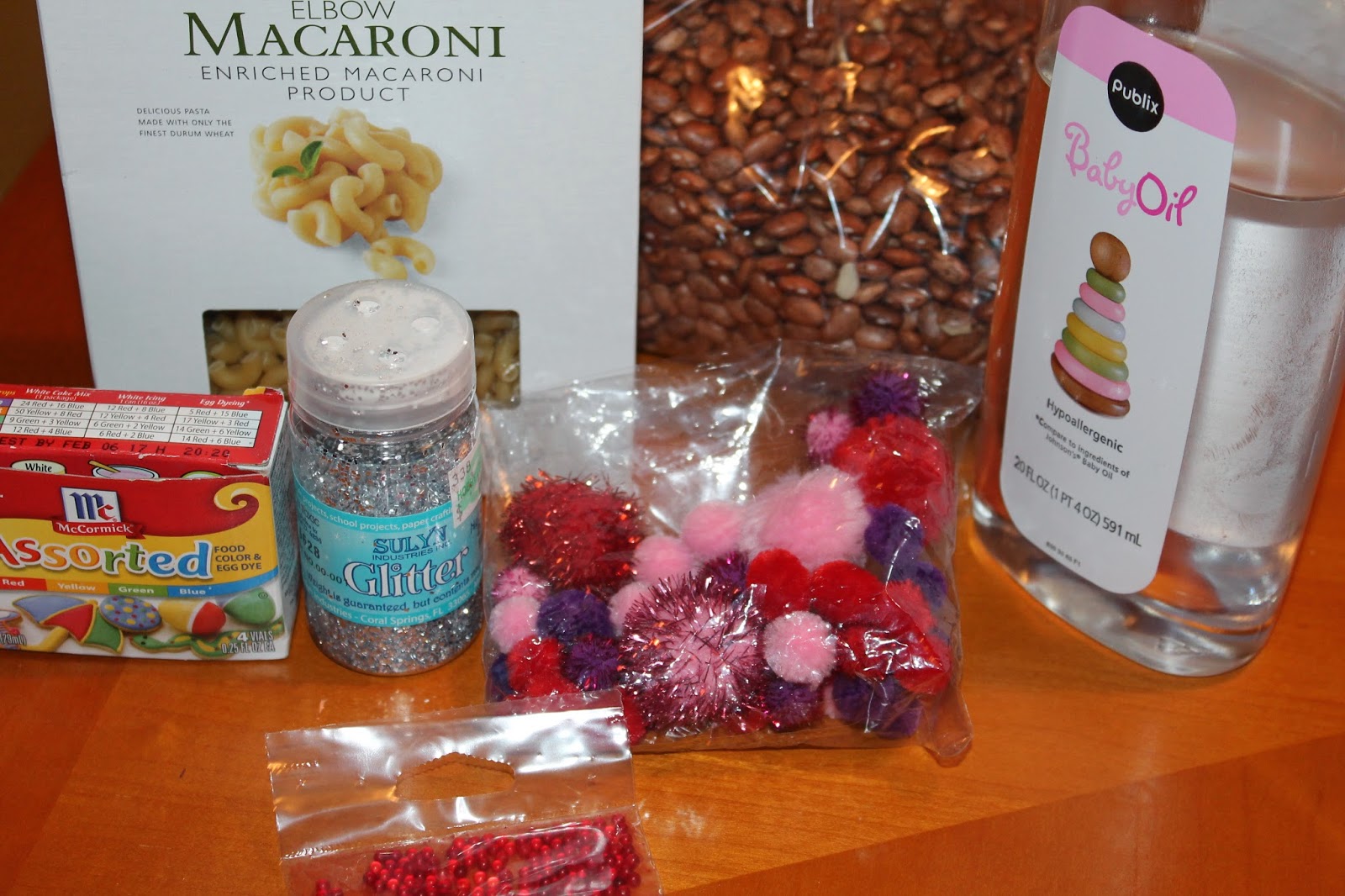
The first are super easy, cheap, and are all over blogs, pinterest, and often done in most day cares…Sensory Bottles. Sensory bottles can be as simple or extravagant as you like. I gathered up a few bottles from our recycling bin. For small hands I would use the tiny water or juice bottles and for older kids regular water bottles would be fine. Next, gather up some fillers from around the house. I wanted to appeal to more than 1 sense (sound and sight) so I filled 1 bottle with some dry beans and pom poms(sound), 1 with dry pasta(sound), one with soaked water beads and food coloring (sound/sight), 1 with oil and colored water (sight), and 1 with colored water and glitter(sight). I filled the bottles about 2/3 full and tightly closed the bottles. I also secured them with a line of hot glue around the rim to deter Sean from opening them but you could also tape the cap on as well. I placed them in a basket and let her play. She loved rolling them on the table and jamming to some music with the noise shakers. Easy, cheap, fun!


For the sensory blocks I purchased 2 wood blocks from the craft the store for a dollar and some sheets of textured paper (shag, animal print, leather, felt, tissue paper). All you do is lay the block on the textured paper and use a pen to trace the square, cut out the square, and adhere with Modge Podge craft glue. These are her favorite; she plays with them alone and with some of her other wood blocks.
Babies use their senses to navigate all of the new stimuli they are bombarded with in those early months of life so providing a variety of sensory experiences really helps them to understand how the world works. For me it’s like watching little scientists make observations and discoveries.


What ways do you help your child explore their senses?